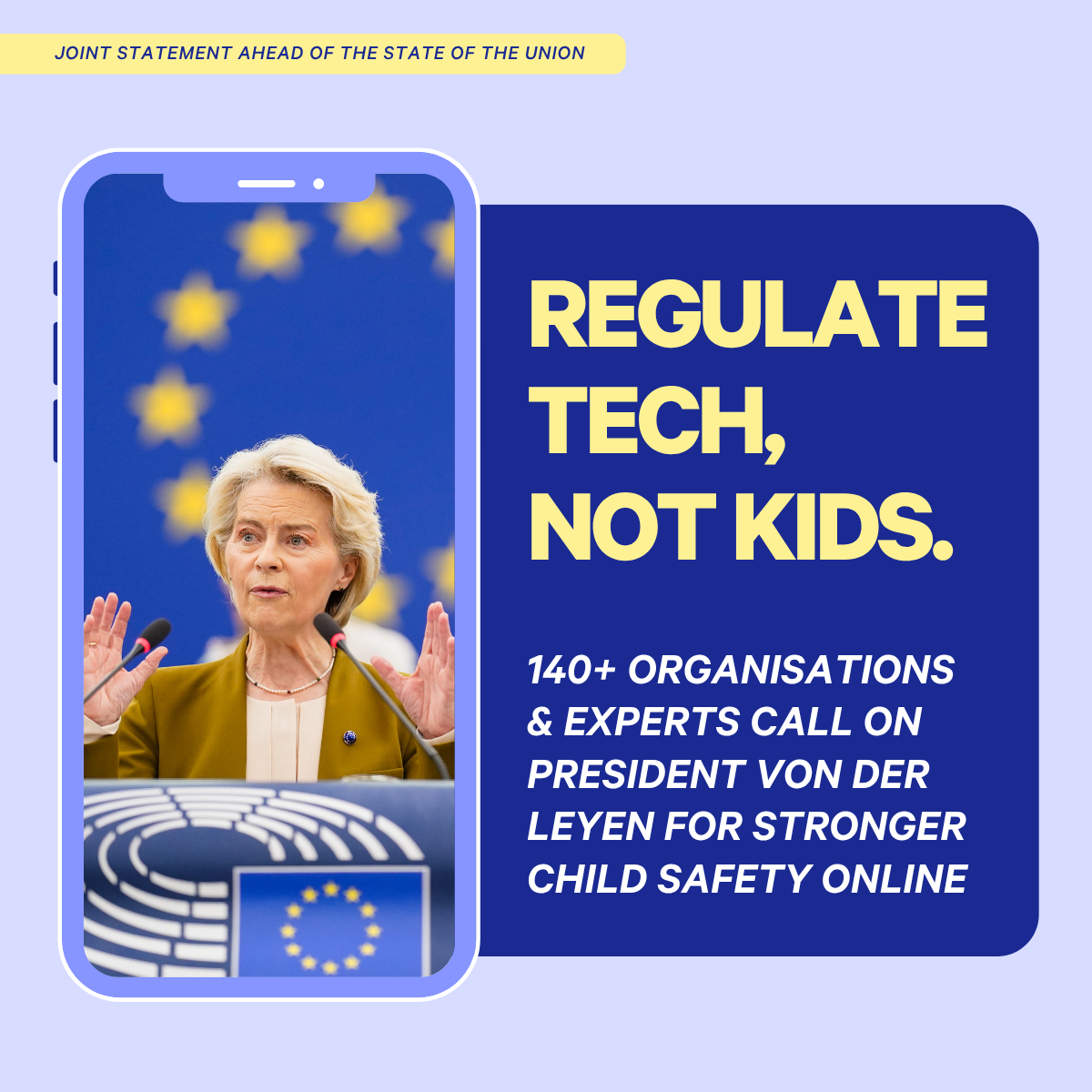
Eurochild reacts to the Council’s position on the Regulation to Prevent and Combat Child Sexual Abuse
On 26 November 2025, after three years of negotiations, EU governments finally agreed on their position on the Regulation to Prevent and Combat Child Sexual Abuse (CSAR). For Eurochild, this is a key moment in our joint advocacy with the European Child Sexual Abuse Legislation Advocacy Group (ECLAG).
The CSAR was proposed by the European Commission in 2022 to introduce EU-wide rules requiring online service providers to prevent, detect, report and remove child sexual abuse material (CSAM) and solicitation of children. During three years of negotiation, the lack of political agreement meant that child protection lagged behind the growing scale of online abuse. Child rights organisations have repeatedly called on EU leaders not to let this file fail.
The Council’s position
The Council’s position paves the way for trilogue negotiations with the European Parliament and the European Commission.
While we are concerned about removing detection obligations and limited enforceability, the position extends voluntary detection on a permanent basis, which was currently possible through the Interim Regulation. The text includes provisions advocated by Eurochild within ECLAG, such as mandatory risk assessment and mitigation for online services. According to the position, providers must analyse how their services could be misused to share CSAM or for the solicitation of children, and implement proportionate measures to mitigate these risks.
The Council text envisages oversight at the national level. Each Member State will designate “coordinating and other competent authorities” to review risk assessments and mitigation measures, with the possibility of obliging providers to implement such measures. The competent national authorities will be empowered to require companies to remove content or, in the case of search engines, to delist search results.
The position introduces three risk categories for services – high, medium and low - based on a series of criteria. High-risk services may face stronger obligations, including contributing to the development of technologies that can mitigate specific risks on their platforms.
The position also requires providers to assist victims who request the removal or disabling of access to CSAM depicting them, and the establishment of an EU Centre on Child Sexual Abuse to support the implementation of the Regulation.
A review clause is included, requiring the Commission to evaluate, within three years of this Regulation's entry into force, the need and practicality of incorporating detection obligations in the future, including an evidence-based evaluation of the reliability and accuracy of the relevant available technologies.
Our continued work to ensure all children are protected from child sexual abuse
These gains are also the result of sustained advocacy by ECLAG. Over the past three years, ECLAG has provided detailed input to the CSAR negotiations and kept public attention on the human cost of inaction. One recent highlight was the ECLAG Week of Action and a powerful stunt on Monday, 13 October in the heart of the EU quarter in Brussels and the video message with recommendations from Eurochild’s NOVA Council (Network of Online Visionaries in Action).
The final shape of the Regulation will be decided in trilogues between the Council, Parliament and Commission. In a public statement reacting to the Danish Presidency Proposal, ECLAG calls for a solution that ‘’combines a permanent legal basis for voluntary detection of all forms of sexual abuse, including grooming, as proposed by the Council, with essential measures such as mandatory mitigation requirements, victim-initiated detection and removal requests, and mandatory obligations for detecting and blocking known child sexual abuse material.’’
Eurochild will further analyse the Council’s position in detail and, together with ECLAG, will remain engaged with EU institutions during the upcoming negotiations. This is a once-in-a-generation chance to build a child-rights framework that prevents and addresses child sexual abuse for all children in Europe. EU leaders must seize this opportunity.
For further information, contact:
- Francesca Pisanu, EU Advocacy Officer
- Sofia Montresor, Policy & Advocacy Intern – Online Safety