What a week in Brussels reveals about children’s rights in Europe
At meetings with EU institutions, Eurochild discussed what’s working and what still needs to improve in turning children’s rights promises into real action. Talks focused on putting the Child Guarantee into practice, securing long-term funding, improving digital safety, and strengthening political commitment to fight child poverty and inequality, especially as pressure on child rights organisations grows.
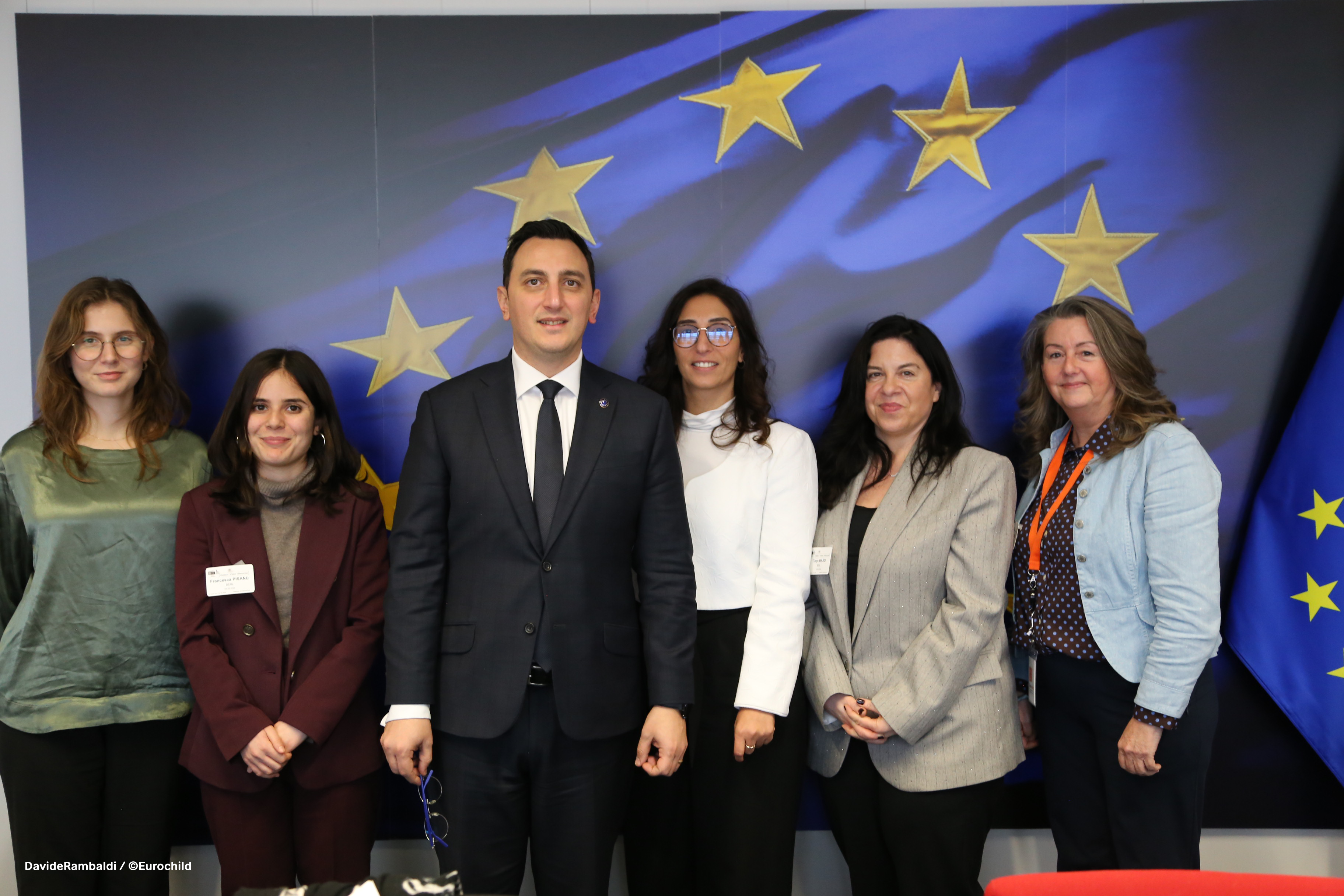
From 3 to 5 February 2026, Eurochild’s President, Tanya Ward, was in Brussels for high-level discussions anchored in Eurochild’s 2025 Flagship Report, Unequal Childhoods: Rights on paper should be rights in practice. Across meetings, the focus was on delivery, financing and accountability.
Discussions with Executive Vice-President Roxana Mînzatu placed the European Child Guarantee at the centre of the agenda, focusing on strengthening national child rights strategies, countering anti-rights narratives and closing implementation gaps. Progress, it was clear, depends heavily on data, monitoring and sustained civil society engagement. That emphasis continued at DG EMPL with Katarina Ivankovic-Knezevic, where childcare shortages and coordination challenges contrasted with advances on free, healthy school meals as a core anti-poverty measure.
Child poverty was consistently framed as a structural and intergenerational issue. Talks with Commissioner Glenn Micallef highlighted the limits of fragmented evidence and outlined plans for an EU observatory to produce comparable data on children’s lives, alongside discussion of cyberbullying ahead of the EU Action Plan published on 10 February. With Executive Vice-President Henna Virkkunen, attention turned to the Digital Services Act, the AI Act and child sexual abuse legislation, emphasising safety by design, age-appropriate online environments and a more nuanced approach to age restrictions.
Questions of political durability surfaced in exchanges with Members of the European Parliament, including Hristo Petrov and Regina Doherty, and in discussions on the European Social Fund Plus, where Eurochild raised concerns about uneven access for civil society and the sustainability of effective initiatives amid uncertainty over the next MFF. Parallel discussions with the European Semester unit underlined its growing influence on investment priorities, particularly when the Child Guarantee is paired with early, preventive investment in ECEC, skills and education.
Looking ahead, discussions at the Irish Embassy focused on Ireland’s upcoming Council Presidency, structured around security, values and competitiveness, with children’s rights expected to cut across all three. A child-friendly version of the Presidency programme is also planned, making EU priorities accessible to children themselves.
The week culminated in a first high-level roundtable of its kind at the European Parliament, hosted by Vice-President and Children’s Rights Coordinator Ewa Kopacz and co-organised with Eurochild and the European Network of Ombudspersons for Children (ENOC). Ombudspersons, EU institutions and civil society came together around three intersecting pressures: tackling child poverty through the Child Guarantee, advancing children’s physical and mental health, and responding to rising anti-rights movements affecting children. Contributions ranged from ENOC’s priorities, including the ENYA (European Network of Young Advisors) project and a focus on LGBTQI+ children, to testimony from Eurochild members describing intimidation, attacks and shrinking civic space. The discussion reinforced the need for better data, adequate funding and staffing of services, and stronger integration of children’s rights impact assessments across EU legislation. This inaugural exchange sets a strong foundation for continued dialogue in the future.
Taken together, the three days offered a clear snapshot of where Europe stands. The frameworks are in place, and the evidence is growing. What remains uncertain is whether implementation, financing and protection of civic space can keep pace. For Eurochild, the coming period will test how far commitments made in policy rooms are carried through into lasting change.
More on the meetings: