High-Level Conference in Zagreb 2026: Advancing the European Child Guarantee Across Enlargement Region
Altin Hazizaj from Eurochild member CRCA Albania attended UNICEF’s meeting on the European Child Guarantee on behalf of Eurochild.
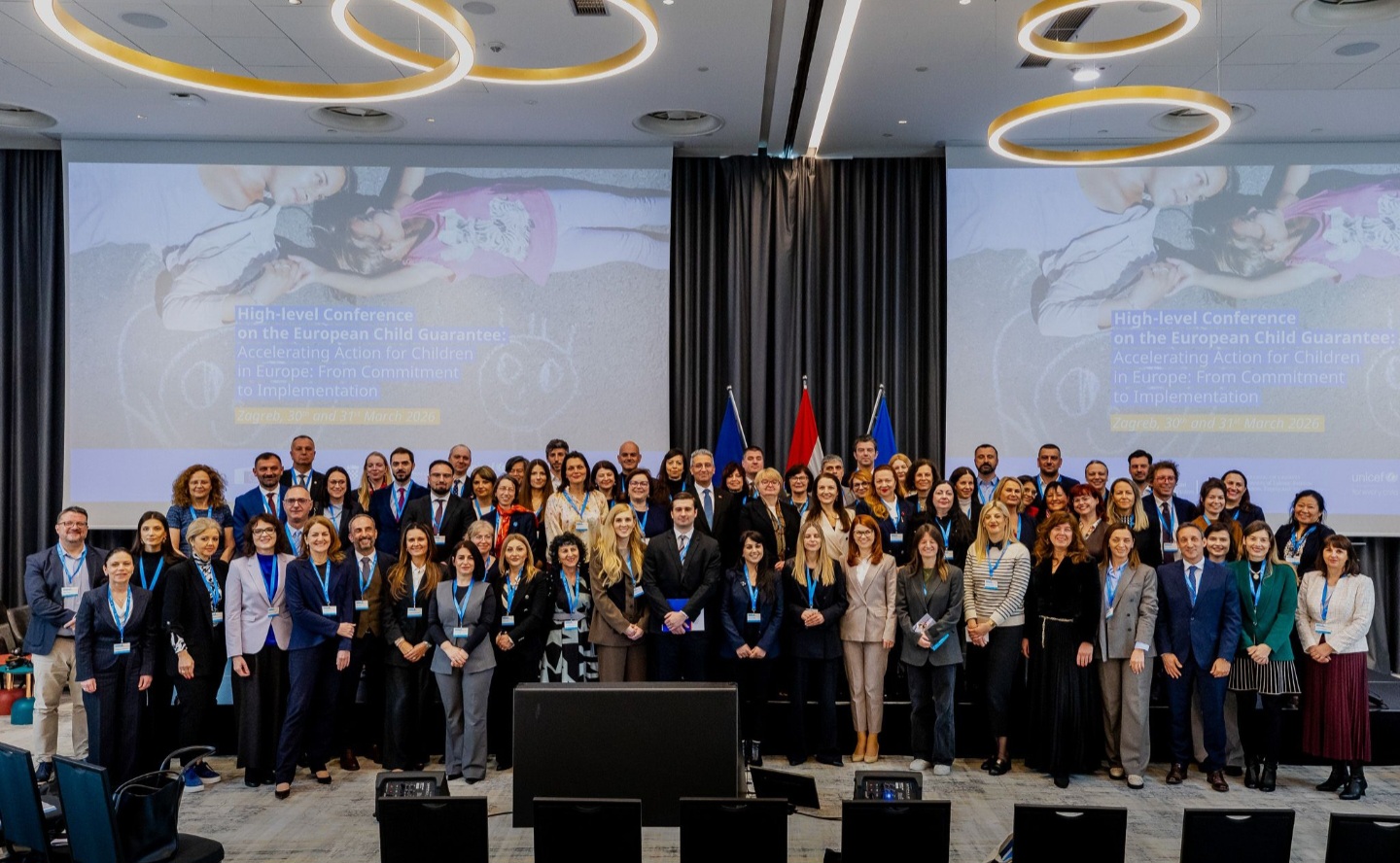
The High-Level Conference on the European Child Guarantee, held in Zagreb on 30-31 March 2026, brought together senior government representatives from EU countries, Eastern Europe and Western Balkans, EU institutions, UNICEF and civil society to discuss how the European Child Guarantee can move from political commitment to real implementation across Europe and particularly in the Western Balkans, Moldova and Ukraine.
For Albania, the meeting was an important opportunity to reflect on the progress made so far. Across several discussions, Albania was often referenced as one of the countries in the Western Balkans that has advanced furthest in the implementation of the European Child Guarantee. This is encouraging not only for Albania, but also because it can serve as a practical pathway and example for other countries in the region that are now entering the process more seriously.
At the same time, the discussions also highlighted a number of important concerns. While UNICEF and the European Union provided updates on the current state of the Child Guarantee, including the new learning hub and regional cooperation mechanisms, much of the space felt heavily institutionally managed, leaving limited room for open and critical dialogue. It was only towards the end of the conference that a more honest discussion emerged around some of the core challenges facing the Child Guarantee today.
Together with other civil society representatives, including our colleague Enrico from Save the Children Europe and the Alliance for Investing in Children, we raised our concerns on the long-term sustainability of the Child Guarantee, particularly in relation to EU funding, national budget commitments and the often-underestimated role of civil society organisations in implementation and monitoring. We also stressed that child participation cannot remain symbolic. If the Child Guarantee is truly about children’s rights and social inclusion, children and young people themselves must be meaningfully involved in shaping policies and evaluating their impact.
The Zagreb meeting confirmed that the European Child Guarantee continues to be one of the most important social policy frameworks for children in Europe. However, its success will ultimately depend not only on technical coordination and political declarations, but on genuine investment of the Governments across EU, Western Balkans and Eastern Europe, accountability and stronger partnerships with civil society and children themselves.