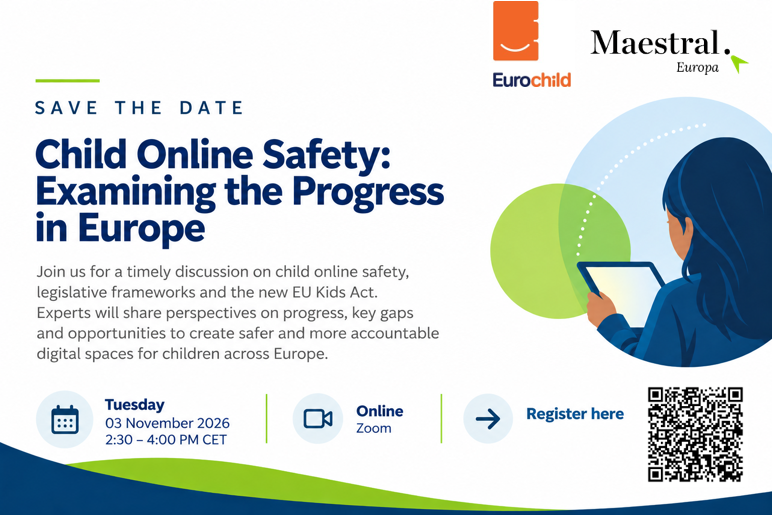
EU KIDS Act: a necessary step to put children’s rights at the heart of digital policy
Eurochild welcomes the proposed EU KIDS Act as a necessary step toward a safer digital environment that upholds the rights of all children. Its differentiated approach recognises that children’s needs, capacities and vulnerabilities evolve throughout childhood and adolescence, although its age thresholds and safeguards require further strengthening.
Eurochild has played a key role in bringing our policy analysis, members’ expertise and children’s experiences into this debate. Our position on age restrictions on social media in February 2026 has enabled us to contribute a strong voice and engage with European Institutions, the media, technology companies and other stakeholders. Our participation in the European Commission President’s Special Expert Panel on child safety online further demonstrates our contribution at the highest level of the EU political agenda.
We particularly welcome the recognition that all children under 18 have the right to protection and age-appropriate safeguards, alongside broad coverage encompassing online social networking services, video-sharing platform services, software application stores, online games, operating systems, AI companions and general conversational chatbots.
The proposal translates safety by design into concrete obligations, although these do not apply equally across all covered services. We welcome safeguards against addictive design, high privacy and security settings by default, and restrictions on unsolicited contact. Requirements on recommender systems and interruptions protecting sleep and school time are further positive developments, but equivalent protections should be extended to services where gaps remain, including online games. We also welcome protections against harmful commercial practices, safeguards addressing AI-related emotional dependency, and accessible tools supporting children’s agency. Child-friendly reporting, priority handling of children’s reports, collective complaints and independent audits offer important avenues for accountability. Protections for users without accounts and strong privacy requirements for age assurance are further positive developments.
To realise this ambition, the proposal should be strengthened in four areas:
Establish a coherent framework and reverse the burden of proof. All providers should demonstrate safety and age-appropriateness before exposing children to services through child-rights risk assessments, independent review, proportionate audits, and ongoing monitoring, including across all platforms. Assess cumulative harms and unequal impacts, clarify exemptions and coordinate enforcement with existing EU legislation.
Ensure safeguards are not dependent on guardian availability. Children’s access to safe, age-appropriate services should not depend on adults’ availability, resources or digital skills. For social networking and general video-sharing services, children aged 13–14 should be able to hold limited accounts independently, with providers applying binding time limits, safe contact settings, high privacy defaults and accessible reporting and confidential support. This would prevent exclusion and disruption of legitimate contacts, particularly for children in alternative care and unaccompanied children. Guardian tools should provide optional additional support, while respecting children’s privacy and evolving capacities.
Close gaps for AI and gaming. Ensure equivalent core protections across services, with additional safeguards tailored to their risks. AI companions and general conversational chatbots should remain unavailable to children under 13, while access for older children should depend on independently demonstrated safety and age-appropriateness. Specialised educational AI limited exclusively to educational functions and not qualifying as an AI companion should be distinguished from these systems. For online games, providers should demonstrate suitable age ranges and apply binding safeguards before allowing children’s access, including effective time controls, stronger contact protections and a prohibition on paid loot boxes and other purchasable randomised rewards for minors.
Ensure inclusive implementation and meaningful participation. Embed accessibility by design and assess unequal impacts through a gender-sensitive, intersectional approach, prioritising children in vulnerable situations. Involve children in designing, testing and reviewing safeguards, supported by independent expertise, research, effective complaints and evaluation of real-world outcomes. Invest in digital literacy, support for families and educators, and shared, accessible, privacy-preserving infrastructure.
The Act offers a promising foundation for lasting change. Eurochild will work with the EU Institutions, members, children and partners to translate this ambition into inclusive protection, meaningful participation and effective accountability.
For more information, please contact Francesca Pisanu, Eurochild Senior Policy Officer.