From local practice to EU policy: The power of investing in grassroots organisations and voices
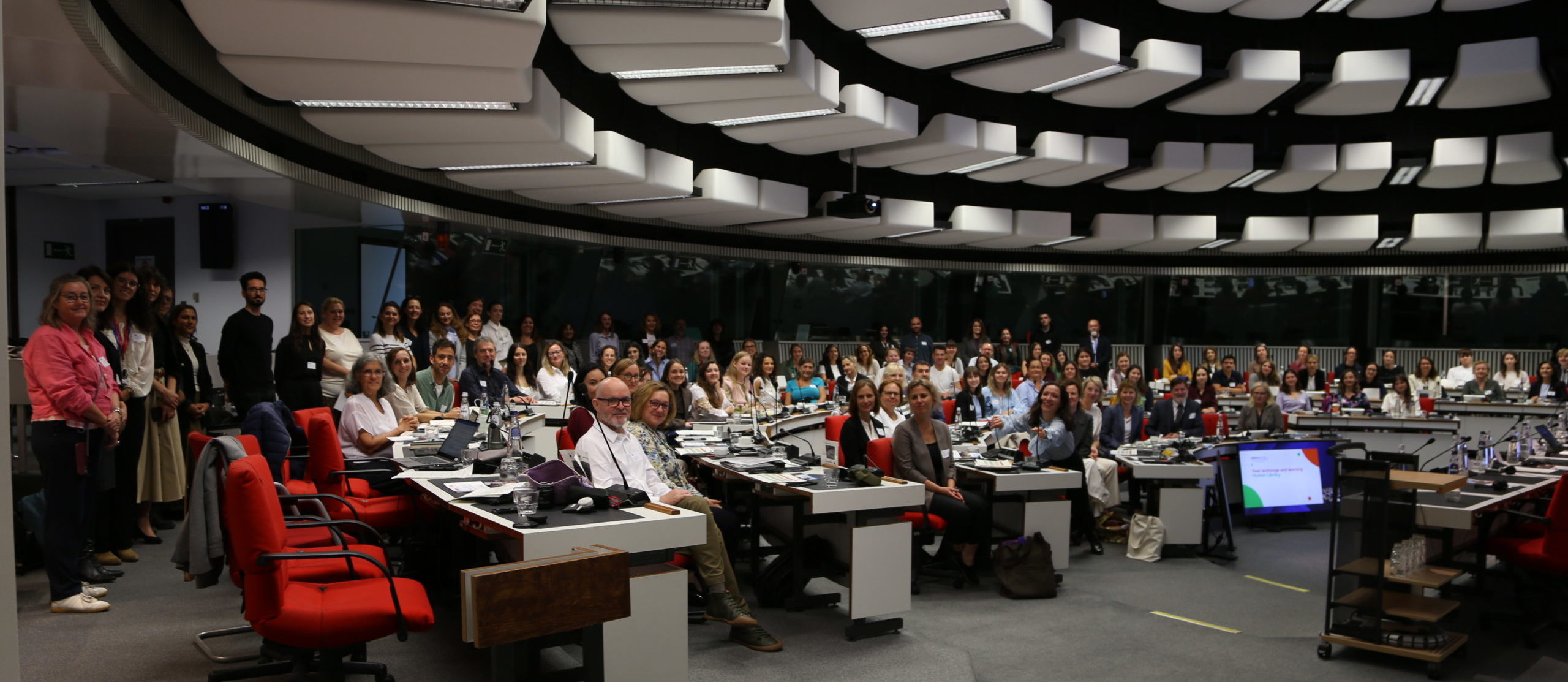
At the #DaphneCHILD High Level Conference, local voices met EU policy, and the message was clear: when funding reaches grassroots organisations, children are safer. Watch the video and look at the photo, highlights and resources.
On 1 October 2026, grantee partners from 48 civil society organisations in 9 countries, including colleagues who travelled from Ukraine, met EU institutions and policymakers at the European Economic and Social Committee (EESC) in Brussels. Four children took part in their own right.
Delivered by Eurochild and Terre des hommes and co-funded by the European Union, Daphne-CHILD has channelled €1.3 million to local projects addressing violence against children. Opening the day, Eurochild Vice President Bruce Adamson called the 48 organisations a rainbow against dark clouds, while Kinga Joó, welcoming participants for the EESC, stressed finding solutions with children, not only for them. Mieke Schuurman, Director of Child Rights and Capacity Building at Eurochild, said: “I am incredibly proud of what Eurochild and Terre des hommes have achieved through the Daphne-CHILD programme, which demonstrates the power of investing in grassroots organisations. Together, we are helping create safer communities where every child’s voice matters.”
Starting with practice
The discussion started with a panel on addressing violence against children with three grantee partners: Tom O’Brien (CASPr, Ireland), the Hintalovon Foundation’s Kid Colleagues group (Hungary), who co-designed and co-led their project, and Tatjana Nikolić (Centre for Girls, Serbia). Tom O’Brien described how a child-led, trauma-informed approach let children turn a conversation about violence into one about kindness; one child’s idea for a kindness protest is now becoming a Kindness Revolution. Tatjana Nikolić explained how women trained as community activists accompany mothers and children to institutions that can otherwise feel out of reach. The Kid Colleagues, who shaped their project’s online free course on children’s rights, reminded the room that children may not be experts in policy, but they are experts in their own lives. Their closing messages: listen with your mind as well as your heart.
From practice to policy
The policy panel, moderated by Mieke Schuurman, turned to the systems needed to support this work. Marie-Cécile Rouillon, Coordinator for the Rights of the Child at the European Commission, said: “The question is: how do we translate children’s rights into reality? The EU legal framework to protect children needs to be supported by policies - such as the EU Strategy on the Rights of the Child, the European Child Guarantee, and the EU Recommendation on integrated child protection systems - and concrete actions. With the CERV Daphne programme CERV-2023-DAPHNE, we wanted to make sure the money would go to grassroots organisations. Civil society organisations are the ones making a difference. The benefit of the project will not stop now, but we will continue building on these good practices.”
Sandra Aigner-Accardo of the EU Agency for Fundamental Rights pointed to a gap in what we know, and proposed a European model of child-oriented budgeting to close it: “When we conducted the mapping of the child protection systems in the EU, we analysed promising practices and suggested ways forward as an independent EU body. The most striking finding regarding the financing of child protection systems is that, in many Member States, we simply cannot see how much is spent on child protection. In only half of the Member States did we find a specific budget for child protection. What cannot be measured is hard to manage.”
Kinga Joó, EESC rapporteur for the EU Child Guarantee, presented the new EESC study Breaking the cycle of disadvantage: “To break the cycle of disadvantage, we must act early and address the interconnected challenges facing children and families. Our recent study on intergenerational poverty highlights how economic hardship, family instability, health issues, housing insecurity, discrimination, and limited access to essential services can overlap and reinforce one another. Fragmented action is not enough; we need integrated child-and family-centred support that brings services together for those who need them. Initiatives such as the Daphne-CHILD programme demonstrate the vital role grassroots civil society organisations can play in developing solutions with and for children, and in translating European rights and policies into tangible support at local level.”
Nessa McKevitt shared how the Irish EU Presidency has put the voice of children at the heart of its programme, in line with one of its overarching priorities on Values. “It is important as policy/decision makers that we don’t just listen to children but ensure children’s voices inform matters that impact their lives, and we let children know how their views have been taken on board or not.”
Closing the morning, Rita Skrebiškienė looked ahead to the Lithuanian EU Presidency: “The work presented through Daphne-CHILD reminds us why integrated child protection systems matter. For a child experiencing violence, protection depends on whether someone recognises what is happening, responds appropriately and helps them receive support. This requires cooperation across services and institutions. It also requires knowledge of organisations working directly with children and families. As preparations for Lithuania’s Presidency of the Council of the European Union in the first half of 2027 continue, we intend to encourage discussion on how European commitments can translate into more accessible and coordinated support for children.”
Lessons from re-granting
After an afternoon Human Library, where participants heard grantees’ stories first-hand, the closing roundtable asked what re-granting can teach the EU. Chrisoula Arcoudis of DG Just called it a clear policy choice: resources must reach the communities where children live and learn. Re-grantors from the Bodossaki Foundation, Educo, MODS, World Vision Romania and Eurochild shared what makes it work: adaptive grantmaking practices, capacity building, peer learning, and trust between funders and local organisations.
What comes next
- -> Watch grantee voices from the day in the conference video, and see photos on Flickr.
- In the coming months, Daphne-CHILD will publish a guidebook capturing results and practices developed from the grantee projects, building on the Children at the Centre handbook.
- We have begun working with external evaluators to evaluate and capture learnings from this re-granting programme, due to be published in March 2027.
- Follow the programme at daphne.childhub.org and on social media with #DaphneCHILD.