Make economic policies work for children
Eurochild releases 2017 Report on the European Semester with a reminder to tackle child poverty
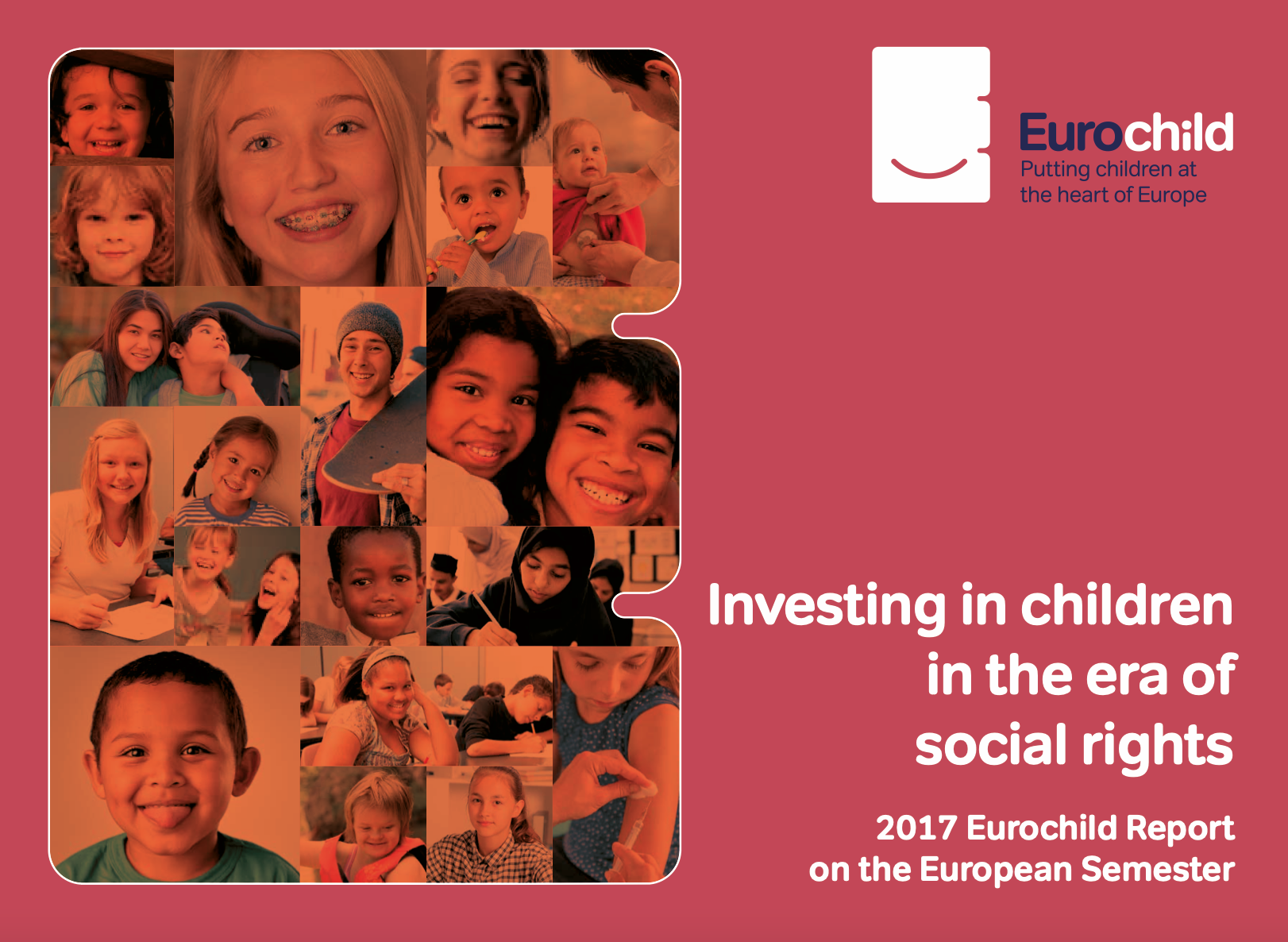
Despite improved focus on social concerns this year, the EU’s economic policies offered fewer recommendations to EU Member States to reduce child poverty and promote children’s well-being, as compared to previous years. Eurochild’s latest yearly report on the 2017 European Semester ‘Investing in children in the era of social rights’ details the situation of child poverty and children’s rights in 18 EU countries.
While the EU has improved performance on its economic indices, more than 1 in 4 children continue to be at risk of child poverty or social exclusion. The European Semester, which is the EU’s annual cycle of economic policy coordination, did not make any recommendations to reduce child poverty in the EU Member States. This is a worrying tendency as there were 7 recommendations made in 2014. Additionally, conflicting recommendations have made it difficult for countries to balance their economic and social priorities.
For example, Spain received a recommendation to improve educational outcomes by providing teacher training and individual support to students, which necessitates investment, while at the same time it was urged to ‘undertake a comprehensive expenditure review’ promoting austerity measures.
“The recognition of social challenges across the EU has been evident this year with the commitment shown at the release of the European Pillar of Social Rights. The economic policy recommendations and tools offered to help EU Member States must also reflect the social reality. The Social Scoreboard offers potential to strengthen the social dimension of the European Semester. We encourage EU Member States to make economic policies work for children and for the Commission to take forward its social analysis into action.” - Jana Hainsworth, Secretary General, Eurochild.
This year, Eurochild members highlighted some positive examples of stakeholder engagement. In the Netherlands, Defence for Children Netherlands has been able to engage productively in the Semester process. By working with the Semester officers in the country, it has contributed with evidence and recommendations based on a children’s rights perspective.
The report ‘Investing in children in the era of social rights’, offers alternative recommendations specific to each country to encourage EU Member States to invest in children.
Background:
Eurochild’s report brings together the assessments of 22 contributors from 18 EU Member States. They looked at the extent to which the European Commission ‘Recommendation on Investing in Children: Breaking the cycle of disadvantage’ (2013) has been implemented in their country and whether the European Semester process is helping or hindering the achievement of positive outcomes for children.
Read the full report ‘Investing in children in the era of social rights: 2017 Eurochild Report on the European Semester’.
The European Commission Recommendation ‘Investing in Children: Breaking the Cycle of Disadvantage’ (20 February 2013) is available online.