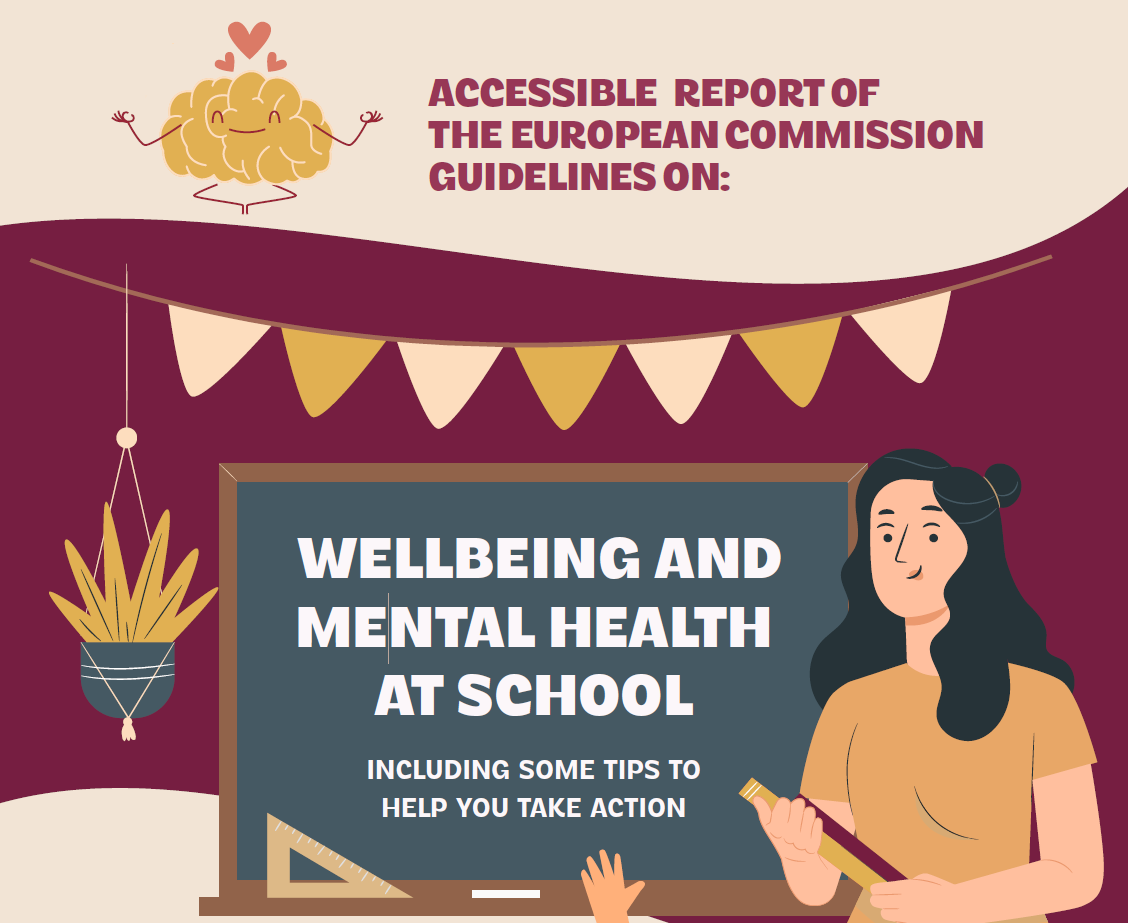
Accessible Report of the European Commission Guidelines on Wellbeing and Mental Health at School
The Eurochild Children’s Council took the lead in reimagining the European Commission Guidelines on Mental Health and Wellbeing at School, turning them into a child-friendly version shaped by and for children.
This publication is the result of a year-long collaboration between Eurochild and the Learning for Wellbeing Foundation, driven by a shared commitment to meaningful child participation. The project was funded by the European Commission’s Directorate‑General for Education, Youth, Sport and Culture (DG EAC).
Created by children, for children, and with children, this guide outlines 10 practical actions to help schools become safer, more inclusive, and nurturing environments. These actions include fostering positive school climates, embedding social and emotional learning from an early age, strengthening partnerships between schools and communities, and ensuring that mental health support is accessible to all pupils.
The report concludes with concrete recommendations for decision‑makers, developed from the views, experiences and priorities of more than 200 children across Europe, gathered through participatory processes including the Eurochild National Children’s Forum and the EU Children’s Participation Platform.
Children were involved as active creators of this child-friendly report, which was based on the European Commission Guidelines on Mental Health and Wellbeing at School, and were supported by Darren Bird, Child Participation Expert, and Laure Pailleau, Eurochild’s Child Participation Officer. Children started working online and then had an intensive three-day in-person meeting, where children collaborated to develop the core content of the child-friendly guidelines and began exploring creative design ideas with the support of professional designers from Brand Studio.
The project concluded in November, when the children returned to Brussels to present the guidelines to EU policymakers, including Vice-President Ewa Kopacz, and representatives from the European Commission's DG EAC and DG JUST.