The Attachment Economy: How AI chatbots exploit children’s need for connection
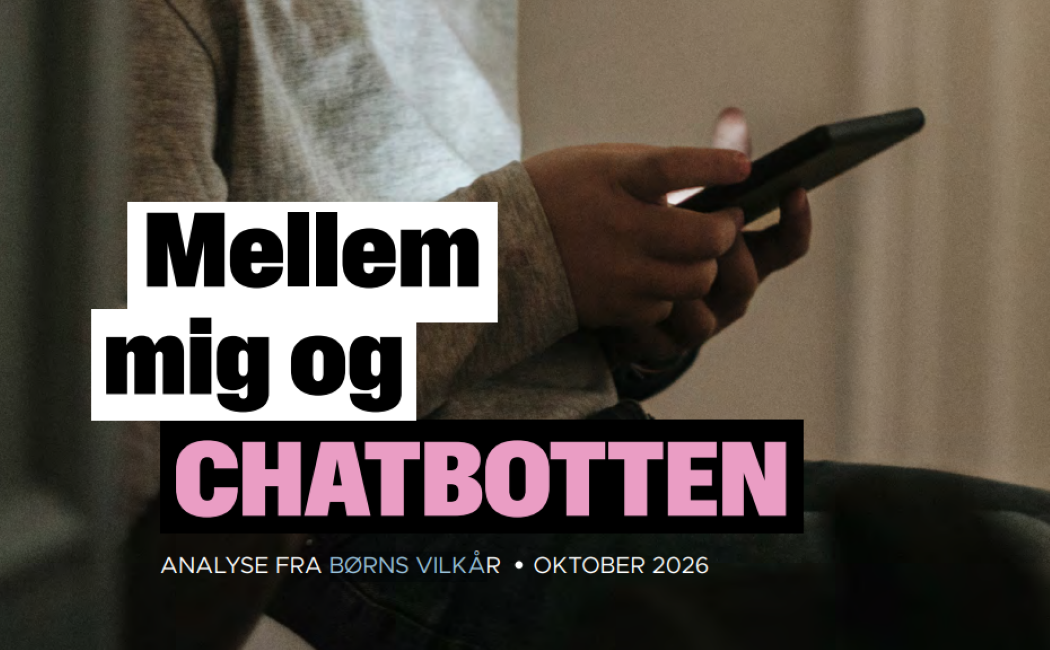
Drawing on their latest report, in this article, Eurochild member Børns Vilkår explores the risks that the emerging “attachment economy” poses to children’s privacy and well-being, and why stronger safeguards are needed.
Since the rise of social media, we have talked about and problematised the so‑called attention economy. An economic model in which our time and attention are the most important currency, and where tech companies develop services designed to keep us engaged for as long as possible, either to influence us or to sell us something. In the attention economy, knowledge about how and how long we engage with specific content on social media is highly valuable. If we spend a long time engaging with content about gardening, that is valuable information for companies that want to sell lawnmowers and tulip bulbs.
But the attention economy is no longer a sufficient concept to describe what is unfolding in the digital sphere. A new economic model has emerged. It is no longer only our attention that is at stake, but rather our need for relationships: compassion, care, mirroring, and so on. Welcome to the attachment economy.
Children’s need for security
In the attachment economy, economic value is created by building and maintaining relationships with users, not only by keeping us in front of the screen, but also by fostering trust and providing the experience of a personal relationship. Qualities that were previously exclusive to human interaction are now being simulated by technology. The tool used for this is AI chatbots.
The stronger the relationship feels, the more the user shares: more thoughts, more feelings, and more private information. This kind of loyalty can be commercially exploited by the companies behind the technology. In the coming weeks, the first targeted advertisements will appear on the popular platform ChatGPT. With the opportunity to market in this way comes an increased incentive to harvest data aggressively.
Children are particularly susceptible to the mechanisms of the attachment economy. Few children have a mature understanding of what AI is or how the technology works. For example, research on children’s digital lives shows that many children have difficulty determining whether the person they are chatting with is a robot or a real human. One child who participated in one of our studies explains that he knows what a chatbot is, yet he is still convinced that “there must be someone sitting there controlling it. Exploiting children’s inherent need for security, mirroring, and recognition is deeply problematic. Yet this is precisely what the companies behind these ingratiating AI chatbots are doing. Beyond the commercial exploitation of a vulnerable consumer group, the rise of the attachment economy also raises serious concerns for children’s psychological development.
“Only talk to my chatbot”
Children’s and young people’s development of social skills depends on relationships that include disagreement, demands, and boundaries. A chatbot never gets angry, makes demands, or requires an apology. It is always understanding and always on the user’s side. If one of a child’s most frequent conversational partners functions this way, human relationships may come to seem difficult and conflict‑laden. As a 12‑year‑old girl writes to the Children’s Helpline’s advice column about her use of an AI chatbot:“I have become addicted, and I can’t be social with people in real life. I only want to talk to my chatbot because he understands me, even though he is a robot.”
For many children, it may feel consequence‑free and more accessible to seek advice about difficult issues on ChatGPT than to reach out to a person in their immediate environment. But AI chatbots are commercial products, and the companies behind them make money from data. When children share thoughts about loneliness, insecurity, health, or family problems, their vulnerability becomes part of a commercial value chain. Even more serious is the fact that there are tragic examples of these ingratiating chatbots driving children toward self‑harm, risky behavior, and even suicide.
In other words, we are talking about a business model designed to coax sensitive information out of children, validate their perceptions of themselves and the world, regardless of what those perceptions are, while simultaneously disclaiming responsibility for the consequences. This should set off alarm bells for everyone.
None of this reflects weakness on the part of children. Children are not irresponsible. They are simply children. Nor can the responsibility be placed on parents. We are dealing with powerful technologies developed by companies that prioritize profit over children’s well‑being and that, despite warnings, launch products that demonstrably can harm children and young people.
AI must be clearly limited
Fortunately, awareness of the potential consequences of AI chatbots for children’s development is growing. The debate is simmering in Brussels, where other children’s organizations are also pointing to chatbots as a blind spot for policymakers, professionals, and parents. At Børns Vilkår, we see every reason to apply a precautionary principle when it comes to chatbots. Children should not chat with bots that have a financial interest in their emotions and that are designed to create attachment. AI can be a useful tool and can also benefit children. But tools do not need to pretend to be human.
When a chatbot ends a conversation with warm phrases and caring formulations, this is not necessary for functionality. It is necessary for the relationship and the attachment, and attachment is what can be converted into profit. If AI chatbots are to be part of children’s lives at all, they must therefore be clearly defined as tools. They must not simulate care, intimacy, or friendship. They must not encourage continuous correspondence and emotional dependency. And they must not collect or use data for commercial purposes.
Several countries have already introduced or announced age limits for social media, Denmark among them. It is positive that the harmful effects of social media are having political consequences. But a ban on social media for children will be insufficient if highly human‑like chatbots are simultaneously allowed to operate freely in the same digital environments. If we are serious about protecting children in digital spaces, AI chatbots must therefore be included in regulation on an equal footing with social media.